
Comprehensive Engineering Architecture for Custom Liquid Cooling Container Data Center Solutions by EXTRCOOL
Sep 17, 2026
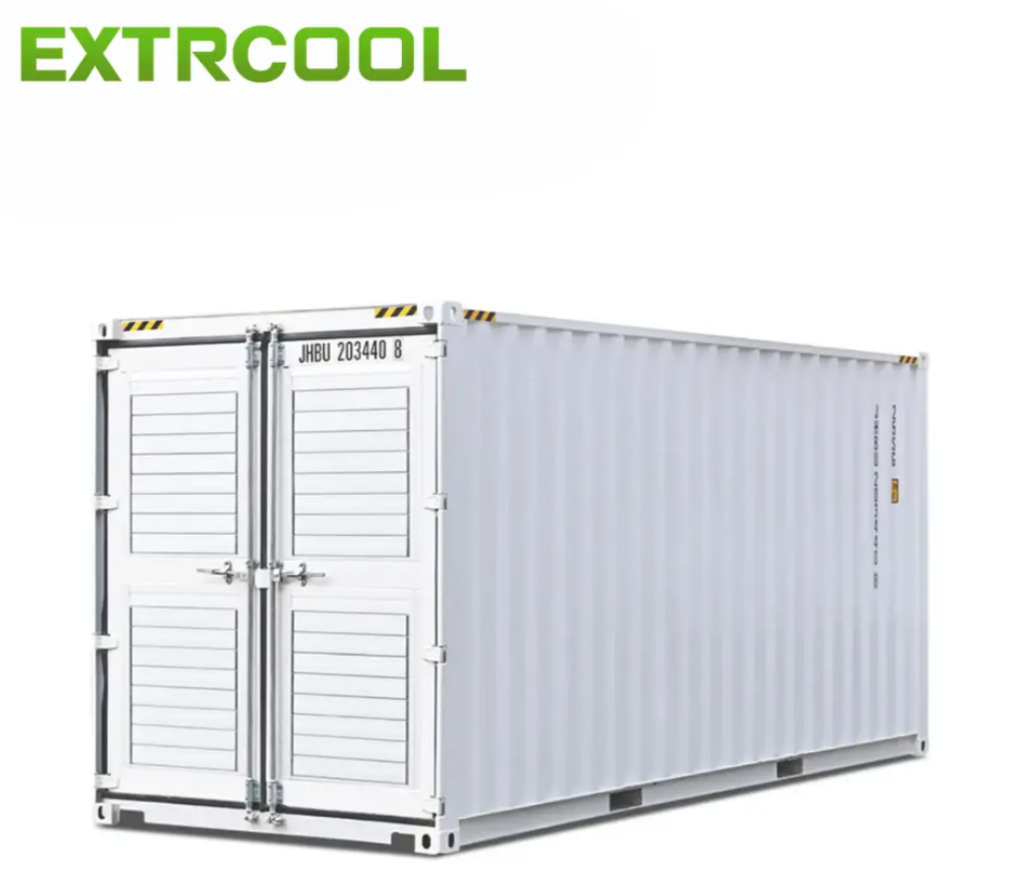
Foshan, Guangdong Sep 16, 2026 (Issuewire.com) - High-density artificial intelligence workloads produce thermal signatures that push traditional air-cooled infrastructure past its physical operational limits. When an AI development firm attempts to deploy a dense cluster of high-power graphics processors inside a standard remote facility, cooling fans quickly reach maximum velocity, ambient cabinet noise levels surge, and core thermal throttling triggers automated performance rollbacks. Air simply lacks the volumetric heat capacity needed to absorb thousands of watts generated within compact server chassis. Managing these concentrated heat loads requires specialized thermal transport mechanisms that can continuously absorb and transport megawatt-scale thermal energy away from sensitive silicon components. Rather than relying on rigid, pre-configured hardware enclosures, modern deployment frameworks use custom liquid cooling container data center solutions designed directly around the specific compute demands, hydraulic dynamics, and environmental profile of each site.
Defining Customization Parameters: Workload and Location
Designing a containerized thermal system starts by evaluating specific compute density targets and regional weather patterns. Next-generation server architecture, such as dense rack nodes powering specialized machine learning models or high-power NVIDIA NVL72 configurations, requires direct-to-chip liquid cooling setups that can absorb massive localized heat outputs without overflowing room thermal capacities. Extrcool Industry Limited configures each unit around these exacting heat specifications, determining total heat removal capacity, fluid pressure requirements, and manifold flow balancing before finalizing physical layout choices.
Operating environments dictate external enclosure protection levels and structural designs. A remote processing site in an arid region with high ambient temperatures and windblown sand requires different thermal protection and heat rejection setups compared to a high-humidity coastal facility subject to salt spray corrosion. EXTRCOOL adjusts shell insulation thickness, anti-corrosion exterior coatings, ingress protection ratings, and overall footprint constraints, fitting complex cooling systems into standard 20-foot or 40-foot intermodal enclosures based on spatial limits, highway transport regulations, and site crane access constraints.
Internal Fluid Loop Integration: CDU, Manifolds, and Heat Exchangers
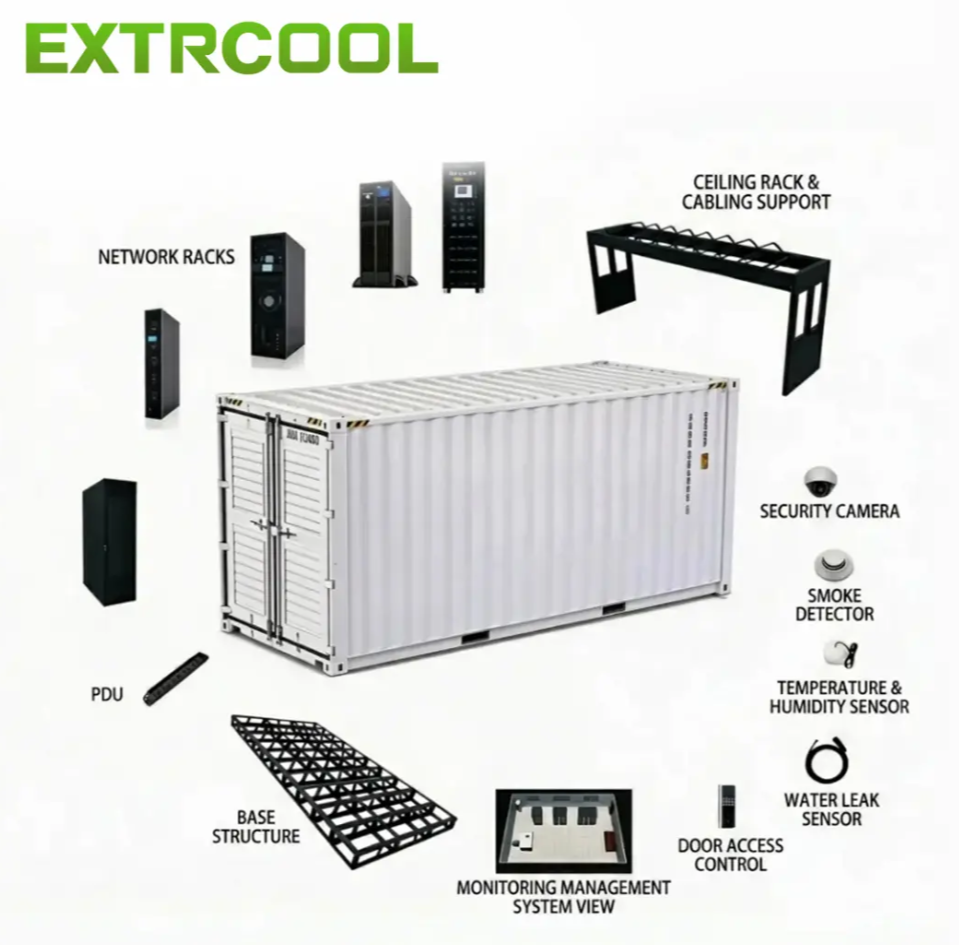
Inside the enclosure, thermal management relies on a closed-loop internal fluid loop where components interact smoothly under automated sensor guidance. Extrcool Industry Limited integrates liquid-to-liquid or air-to-liquid Coolant Distribution Units, stainless steel distribution manifolds, and rear door liquid cooling heat exchangers into a single, cohesive hydraulic system. Engineering teams size pump capacities, secondary loop flow rates, and internal filtration metrics based on dynamic thermal simulation modeling to eliminate localized hot spots across all active rack positions.
1. Coolant Distribution Units
Coolant Distribution Units deliver precise fluid flow rates, controlled operating pressures, and exact temperature differentials across primary and secondary cooling loops, ensuring that dielectric fluids or treated water mixtures remain within stable operational viscosity and temperature parameters.
2. Quick-Disconnect Assemblies and Secondary Piping
Deployment of custom liquid cooling container data center systems utilizes quick-disconnect fittings and corrosion-resistant secondary piping to prevent fluid leakage, suppress bacterial growth, and maintain fluid purity over years of continuous operation.
3. Stainless Steel Manifold Arrays
Stainless steel manifolds split flow evenly across every chassis level, utilizing balanced internal bore diameters to ensure uniform pressure distributions across every individual cold plate assembly across the entire cabinet depth.
4. Rear Door Heat Exchangers
Rear door heat exchangers capture residual ambient heat dissipated from non-liquid-cooled server components, such as memory modules and voltage regulators, keeping internal cabinet air temperatures completely neutral and reducing auxiliary fan energy usage.
Outdoor Enclosure Engineering and Dry Cooler Matching
Exterior heat rejection equipment must match the internal fluid loop to maintain low energy usage across changing seasonal ambient conditions. EXTRCOOL pairs custom liquid cooling container data center configurations with free-cooling dry cooler systems designed for specific climate profiles. When ambient temperatures drop below target return fluid thresholds, these systems automatically bypass active mechanical chillers, relying entirely on ambient air to reject heat and reducing overall facility electrical consumption.
The physical container acts as the first line of defense against harsh weather conditions and mechanical damage. Extrcool Industry Limited builds liquid cooling container data center solutions using weather-resistant, multi-layered insulated panels that prevent internal surface condensation and shield sensitive IT equipment from blowing dust, torrential rain, and continuous solar thermal radiation loading. Integrated sensing networks track moisture levels, secondary loop fluid pressure drops, and primary pump operational status in real time, automatically adjusting valve positions and alerting off-site facility operators if fluid parameters drift away from prescribed baseline windows.
Deployment Process and Field Integration
Transitioning from initial thermal concepts to working field facilities follows a systematic five-step engineering workflow that simplifies site installation and shortens commissioning timelines:
- Site assessment and computational fluid dynamics modeling establish precise thermal heat loads, structural loading limitations, and local atmospheric weather baselines for the targeted installation region.
- Hydraulics engineering teams match CDU pump output, internal piping diameter, manifold branch sizing, and external dry cooler radiator capacities directly to the expected compute density.
- Factory assembly, hydrostatic pressure testing, and thermal load simulation occur inside controlled manufacturing facilities to verify fluid tightness and thermal performance prior to physical shipping.
- Transport and quick-connect site assembly allow field technicians to position the enclosure, secure external power runs, and connect pre-plumbed secondary plumbing lines with minimal site disruption.
- Automated remote monitoring integration connects internal sensor networks to central facility management dashboards, enabling continuous oversight of flow rates, temperature deltas, and system health.
Factory-prefabricated infrastructure allows data center operators to expand computing capacity rapidly without undertaking months of expensive, disruptive site construction. Implementations featuring custom liquid cooling container data center solutions arrive on-site fully assembled, pressure-tested, and ready for immediate service connection. By matching specialized thermal hardware directly to exact compute requirements, EXTRCOOL helps data center operators maintain stable operational conditions, target a Power Usage Effectiveness below 1.05, and scale server density reliably.
For detailed technical specifications and custom thermal engineering inquiries, please visit https://www.extrcool.com/
Media Contact
Extrcool Industry Limited
No., 1003 Tianfulai Industrial Zone, Shunde, Foshan of Guangdong China
Source :Extrcool Industry Limited
This article was originally published by IssueWire. Read the original article here.
Recommended



YOUR NEWS, OUR NETWORK.
Do you have Great News you want to tell the world?
Be it updates about your business or your community, you can make sure that it’s heard by submitting your story to our network reaching hundreds of news sites across 6 verticals.
More News

US ambassador says Korea-US alliance 'linchpin' of peace on Korean Peninsula
U.S. Ambassador to Korea Michelle Steel on Friday highlighted the Korea-U.S. alliance as the "linchpin" of peace and security on the Korean Peninsula and in the Indo-Pacific. Steel made the remarks at a forum in Seoul, noting the bilateral alliance was forged over 70 years ago with blood and sacrifices made in the 1950-53 Korean War. "For more than 70 years, the U.S.-ROK alliance has been the linchpin of peace and security on the Korean Peninsula and throughout the Indo-Pacific," Steel said in her opening address, referring to Korea by its official name, the Republic of Korea. "Our mutual defense treaty is an unbreakable bond," she added. "But our alliance is more than an agreement between governments. It is also a human story. It is our story." Steel stressed that Seoul and Washington share "one story" forged in war and secured by American and Korean soldiers who stood "shoulder to shoulder" to defend freedom during the Korean War. Highlighting that Korea has now become a "global leader" in a number of areas, including technology, culture, manufacturing and democracy, Steel said such an

Lee reaffirms commitment to establishing peace regime on Korean Peninsula
President Lee Jae Myung on Friday reiterated his commitment to replacing the armistice that suspended the 1950-53 Korean War with a permanent peace regime. The president made the remarks in a speech at a ceremony at the National Assembly commemorating the Pyongyang Joint Declaration, signed on Sept 19, 2018 by then President Moon Jae-in and North Korean leader Kim Jong-un following their summit in Pyongyang. The speech was read on his behalf by Kim Kyoung-soo, Lee's special aide for political affairs. The 2018 declaration affirmed the two Koreas' determination to end military hostility across their border and to boost cooperation. Lee said that despite the declaration, inter-Korean dialogue and cooperation have ceased while tensions have risen, highlighting North Korea's rapid advancement of its nuclear weapons capabilities in the meantime. Now, South Korea is witnessing signs of hope for the resumption of dialogue between North Korea and the United States, the president noted, pledging to help expedite its resumption and efforts to have it develop into dialogue for a peace regime on the

Nearly two million Quest Apartment Hotels customers affected by data breach
Experts say the incident raises fresh questions about how long companies are retaining customer data for.

Former Indian restaurant could become microbrewery and pub
A closed restaurant could become a new nanobrewery, serving beers from locally produced ingredients, after plans were submitted.

Derbyshire woman, 81, spends £50,000 fighting council so she can walk through her own garden gate
Helene Ball, 81, has won a costly legal dispute against Derbyshire County Council over her garden gate access rights

Long delays on major A-road amid emergency gas works
Drivers are facing delays on a major route while crews tackle emergency gas repairs.

Coronation Street fans think they've rumbled Ross Wilkes' end as they 'switch off' over child target
Ross Wilkes' latest move has left Corrie fans horrified

‘Don’t touch them’: Bird flu confirmed after 400 found dead at nature reserve
More than 400 birds have died at a popular nature reserve where part of the site is closed and visitors have been warned not to touch them.

What happened to Kent’s one-of-a-kind giraffe hotel?
Plans for a new hotel where guests could dine with giraffes are in limbo - despite a 9,000-strong waiting list.

Prisoner stabbed fellow inmate in head with pen after being told to be quiet
A violent prisoner who once threw a kettle of boiling water at a guard has now admitted stabbing a fellow inmate in the head 10 times with a pen.

‘It's devastating’: Family’s heartbreak at death of much-loved mum-of-three aged 30
A family have been left devastated by the death of a much-loved mum-of-three aged just 30.

Missing Lillia search LIVE as mum issues plea to Bolton girl, 13, one week after she vanished - updates
An urgent appeal has again been issued for 13-year-old Lillia