
Beady AI Launches Sanctions Screening Software That Checks Customers and Counterparties Every Day
Oct 22, 2026

Beady AI launches sanctions screening software that checks customers and partners against OFAC, EU, UN and UK lists every day.
Hong Kong, Hong Kong S.A.R. Oct 21, 2026 (Issuewire.com) - Beady AI has launched sanctions screening software that checks a company's customers, owners, directors and business partners against the major global sanctions lists on a daily basis. The company says the tool removes most of the false matches that compliance staff currently spend hours clearing by hand.
Any business that onboards clients, pays suppliers or invests in other companies is expected to make sure it is not dealing with a sanctioned party. In practice, that means checking names against the lists published by the U.S. Treasury's Office of Foreign Assets Control (OFAC), the European Union, the United Nations and the UK's HM Treasury. Getting it wrong can mean frozen payments, heavy fines and damage to a company's reputation.
Many firms still handle this with spreadsheets and manual searches, or with older software that matches on names alone. Beady AI points out that name matching flags everyone who happens to share a name with a sanctioned person, and in many systems more than 90 percent of alerts turn out to be false. There is also a timing problem. A customer is usually checked when the account is opened and then again at the next annual or quarterly review. If that customer is sanctioned in between, the business may not find out for months.
Beady's approach is to check each potential match against more than the name. The software compares identifiers, ownership records and the source of the listing before it decides whether a match is worth an analyst's attention. According to the company, this removes up to 95 percent of false positives before anyone has to review them. Each confirmed hit includes a link to the original public record, so a compliance officer can show an auditor or regulator exactly where the information came from.
Screening is not limited to customers. The software also covers ultimate beneficial owners, meaning the people who actually own or control a company, as well as directors, employees and politically exposed persons (PEPs). PEPs are people in prominent public roles who carry a higher risk of bribery or corruption. On the company side, Beady draws on records for more than 200 million businesses and their officers, which helps trace ownership through shell companies. Ships can be checked by their IMO number and aircraft by tail number, something shipping, logistics, trade finance and insurance firms often need.
The same names are also run against PEP databases, adverse media, and international most-wanted and crime registries. In total, Beady monitors more than 100,000 public sources, and these are refreshed every day.
Customers can choose a one-off check, typically used before signing a deal or opening an account, or ongoing monitoring. With monitoring switched on, each entity is rescreened several times a day, so a new sanctions designation shows up within hours. The most serious alerts can be sent straight to a messaging app such as Telegram. Analysts can also bookmark findings and pull them into a single report to share with colleagues. Beady says it works only with publicly available data, and that its software classifies and summarizes what it finds without adding anything of its own.
"Sanctions lists change constantly, and a check that happens once a year leaves a business exposed for the other eleven months," said a spokesperson for Beady AI. "Compliance teams told us they were buried in alerts that went nowhere. We wanted to give them a short list of real matches, each one backed by a source they can open and verify."
The company expects the software to be used by fintech and crypto firms, banks, insurers, investment funds and law firms, along with healthcare providers, government agencies and large corporations. New accounts can usually be set up within a day.
Full details are available on Beady's sanctions screening software page.
Source :Beady AI
This article was originally published by IssueWire. Read the original article here.
Recommended



Sam Wood launches fresh bid for freedom

ABC reporter saves man from sinking car
ABC reporter saves man from sinking car



Marnus throws away wicket with brain snap
YOUR NEWS, OUR NETWORK.
Do you have Great News you want to tell the world?
Be it updates about your business or your community, you can make sure that it’s heard by submitting your story to our network reaching hundreds of news sites across 6 verticals.
More News

Midwest veterinarian wrote multiple suicide notes then killed his elderly parents, girlfriend, son and himself at home, cops say
Bryan Schmidt, 51, who ran the Northern Illinois Cat Clinic, left suicide notes inside his vehicle and at his parent's home before police said he killed his family and took his own life.

Shocking TV show exposes how Brits failed to speak up when shown around a care home... run to NAZI ideals
Channel 4's controversial documentary The Experiment, which aired on Thursday night, aimed to show how the public might react if people with disabilities were segregated from society.

Neighbor who allegedly fed coyote involved in Atwater Village attack could be charged
A resident who allegedly fed a coyote in Atwater Village for months may now face a criminal charge after a toddler was bitten in the neighborhood.

'I felt degraded. Treated like an animal, a piece of meat': Russell Brand's alleged victim says she was left with a sense of guilt
The comedian is accused of assaulting the then 21-year-old as she begged him to stop days after meeting her at a gig in 2009.

Popular CBS TV host leaves her job in mysterious circumstances just months after making comeback from personal tragedy
Dagmar Midcap has disappeared from screens after a brief return to Atlanta, 15 years after fleeing the city following her boyfriend's death.

Receivers to sell mainland developer Shimao’s 2 Hong Kong hotels for US$344 million
Receivers of the Sheraton Hong Kong Tung Chung Hotel and the Four Points by Sheraton have agreed to sell the dual-branded complex, which together comprise the city’s third-largest hotel by room count, for HK$2.7 billion (US$344 million), Shimao Group announced on Thursday. In a filing to the Hong Kong stock exchange, the distressed mainland Chinese developer said the buyer was Oceanfront Hong Kong Limited. Oceanfront is owned by, among others, investment vehicles associated with ParkCity Group,...

Rare earths resource boost in sight as Red Metal drills Qld giant
Red Metal has launched a 5000m drilling campaign at Sybella near Mount Isa, Queensland, aiming to grow its 4.795Bt resource ahead of a prefeasibility study.

Hong Kong ranks 24th in global rule of law index as overall score falls
Hong Kong has been ranked 24th in the latest global rule of law index, despite slipping slightly in the fundamental rights and criminal justice categories. The index, released by the World Justice Project on Wednesday, showed the city remained among the world’s top 10 for “absence of corruption” and “order and security”, rising to seventh in the latter category. The organisation said the global erosion of the rule of law slowed in 2026, but the overall decline continued, with 62 per cent of the...

Making it in the metropolis
This is the sixth in a series of factsheets about Hong Kong’s first five-year plan and the 2026 policy address. Click here to view the other factsheets. The series has been produced with support from the Hong Kong SAR government. To see the South China Morning Post’s coverage of the five-year plan, click here. This Factsheet will appear in the SCMP print edition on October 26. You can find the newspaper at newsstands and convenience stores. For inquiries, contact [email protected].
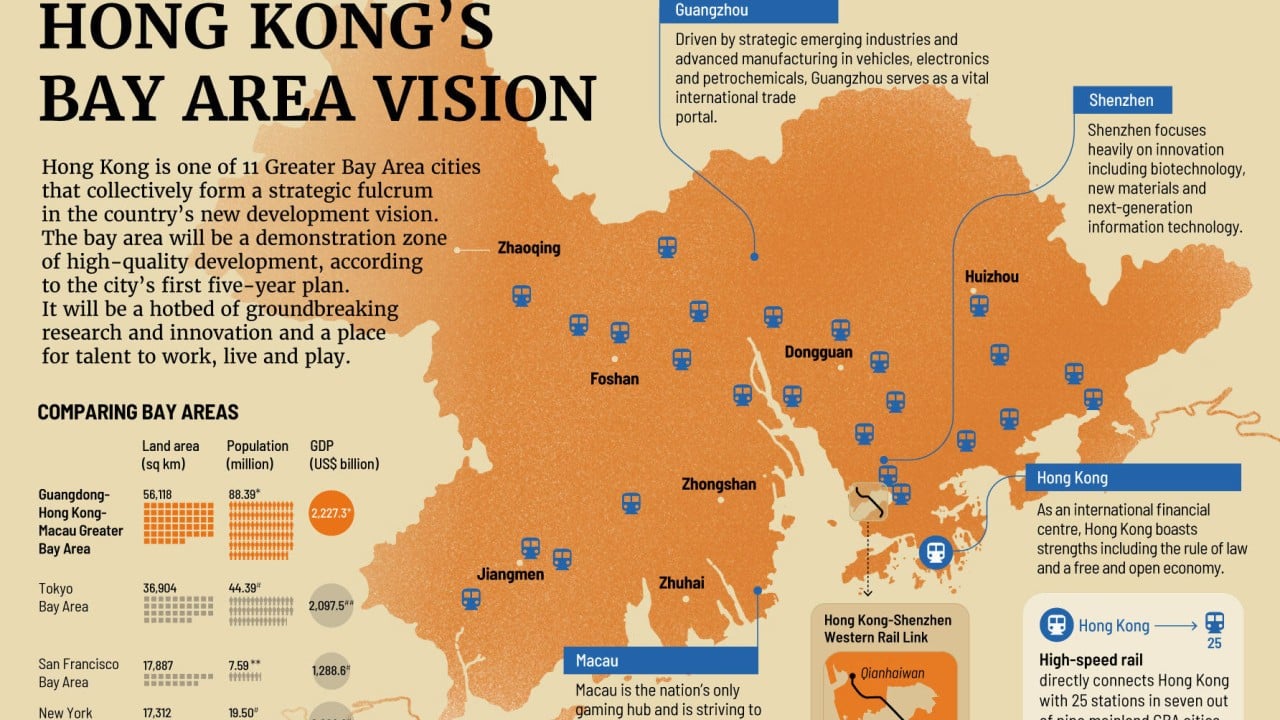
Hong Kong’s Bay Area vision
This is the fifth in a series of factsheets about Hong Kong’s first five-year plan and the 2026 policy address. Click here to view the other factsheets. The series has been produced with support from the Hong Kong SAR government. To see the South China Morning Post’s coverage of the five-year plan, click here. This factsheet will appear in the SCMP print edition on October 26. You can find the newspaper at newsstands and convenience stores. For inquiries, contact [email protected].

An AI apocalypse? Hong Kong’s real challenge is much less dramatic
For many of us, artificial intelligence (AI) started out as something to play with. We asked it to write poems and arrange our calendars; we shared its more entertaining mistakes. Then it became something to believe in: an escape from drudgery, an assistant to every profession, even perhaps the start of a new industrial revolution. Now it is something to fear. The progression has been astonishing. Governments are scrambling to draw up AI strategies, companies are reorganising operations and...

Chaos erupts at Trump's South Carolina rally as protesters posing as MAGA fans try to derail event before loyalists step in to the delight of president
President Donald Trump's Wednesday night rally in South Carolina was interrupted by a series of protesters.